Detection vs Content Credentials
AI Video Detector analyzes videos for synthetic signals, while Content Credentials embed provenance metadata at creation. They solve different parts of the trust problem.
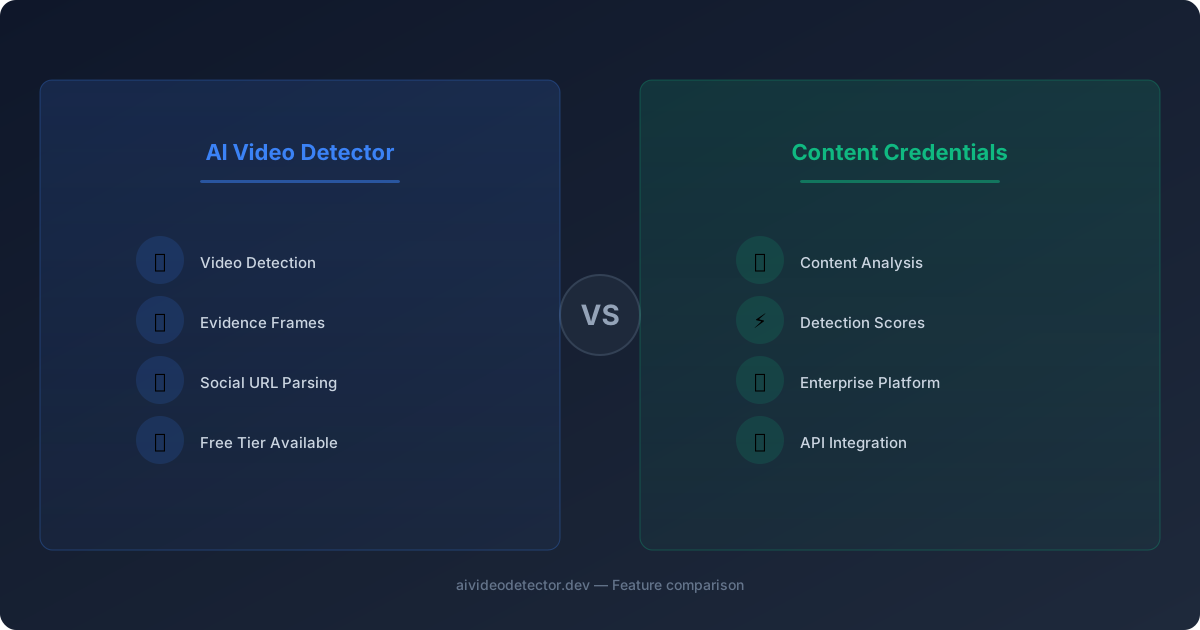
| Feature | AI Video Detector | Content Credentials (C2PA) |
|---|---|---|
| Approach | Analyzes video content for AI generation signals | Embeds cryptographic provenance at creation time |
| When It Works | Works on any video, regardless of how it was created | Only works if the camera/software supports C2PA |
| Coverage | Detects signals from multiple AI models (Sora, Veo, Kling, etc.) | Verifies origin if metadata was attached |
| Limitations | Results support review, not absolute proof | Metadata can be stripped or lost during sharing |
| Ease of Use | Paste URL or upload, get instant results | Requires C2PA-compatible tools to verify |
| Best For | Reviewing suspicious videos after the fact | Establishing provenance at creation time |
How to Choose
Detection vs Content Credentials is not a either-or decision — the two approaches complement each other. Content Credentials (C2PA) embed cryptographic provenance at the time a video is created, so they work best when the camera or editing software supports the standard. AI Video Detector analyzes the video content itself for AI-generation signals, so it works on any video regardless of how it was produced.
Choose Content Credentials when you control the creation pipeline and want to establish provenance from the start. Choose AI Video Detector when you need to review suspicious content after the fact, especially when Content Credentials metadata is missing, stripped, or unavailable. For a complete verification workflow, use both: Content Credentials for creation-time provenance and AI Video Detector for post-hoc analysis.
Verdict
These tools are complementary, not competing. Use Content Credentials when available to verify provenance. Use AI Video Detector when Content Credentials are absent or you need to analyze suspicious content.
Frequently Asked Questions
What is the difference between AI video detection and Content Credentials?
AI video detection tools like AI Video Detector analyze video content for AI-generation signals after the video exists. Content Credentials (C2PA) embed cryptographic metadata at creation time to prove a video's origin. They solve different parts of the trust problem and work best together.
Are Content Credentials better than AI video detection?
Neither is strictly better. Content Credentials only work if the camera or software supports C2PA, and metadata can be stripped during sharing. AI Video Detector works on any video but provides probabilistic results rather than cryptographic proof. Use both for the strongest verification.
Can AI Video Detector replace Content Credentials?
No, they serve different purposes. AI Video Detector detects AI-generation signals in existing videos. Content Credentials establish provenance at creation time. They are complementary tools in a verification workflow.
Product names, logos, and brands referenced on this page are property of their respective owners. Use of these names is for identification and comparison purposes only and does not imply endorsement.
This comparison is based on publicly available information gathered from competitor websites, documentation, and public pricing pages. Features, pricing, and capabilities may have changed since the last review. Please verify current information on each vendor's website.
"AI Video Detector" is a product of aivideodetector.dev. All other product names are trademarks of their respective companies.
Last reviewed: 2026-07-06
What may have changed since this review: C2PA adoption has been expanding across camera manufacturers and editing software. More devices and platforms may now support Content Credentials than at the time of this review.
Found an error? Contact us at support@aivideodetector.dev with a link to the current information.
Sources
This comparison was built using publicly available information from the following sources. Data was last verified on 2026-07-06.
- Content Credentials — Official Website(accessed 2026-07-06)
- C2PA Specification(accessed 2026-07-06)
- Adobe Content Authenticity Initiative(accessed 2026-07-06)
Related
AI Video Detector vs Hive Moderation
CompareAI Video Detector vs Sensity
CompareAI Video Detector vs WasItAI
CompareAI Video Detector vs AI or Not
CompareAI Video Detector vs Illuminarty
CompareAI Video Detector vs Deepware Scanner
GuideDetect AI-Generated Videos
TechnologyDeepfake Detection Techniques 2026