Deepfake in Elections: Verify Videos
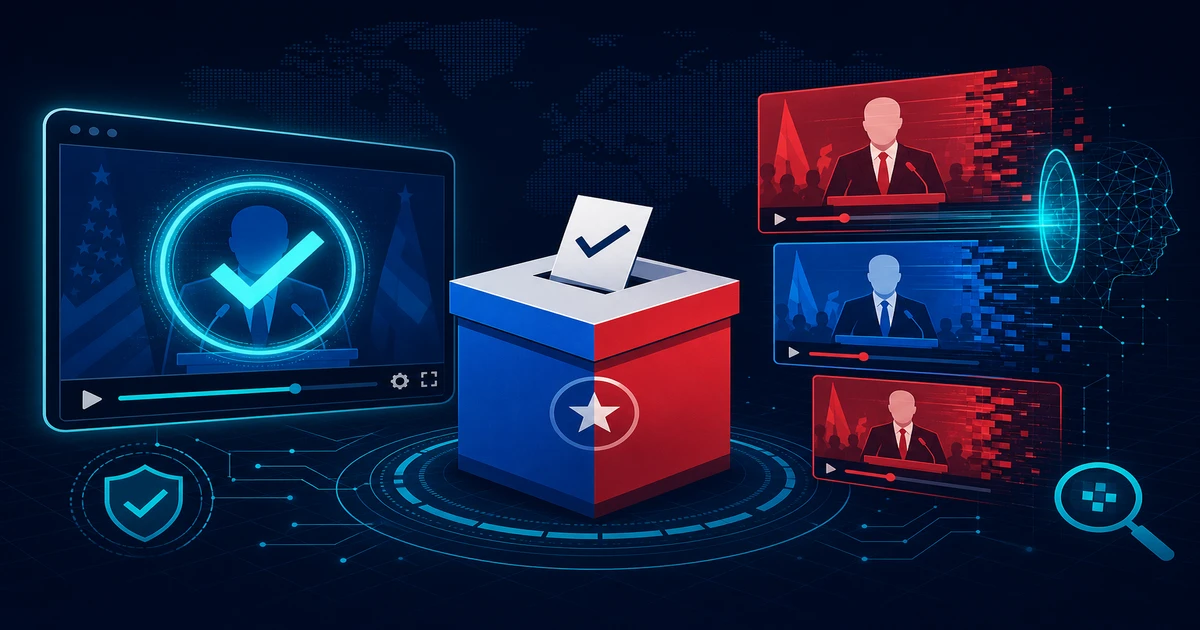
**Short answer:** To verify a political video for deepfakes, run it through an AI detection tool for a confidence score and evidence frames, check the original source and upload history, cross-reference the claims with official records, and consult fact-checking databases. No single step is sufficient — combine automated detection with source verification and human judgment for reliable results.
Elections are the highest-stakes environment for deepfake video. A fabricated video of a candidate making a racist remark, confessing to a crime, or appearing incapacitated can swing public opinion in the critical final days before a vote. By the time fact-checkers publish a debunk, millions of voters have already seen and formed impressions from the fake. Recent election cycles have seen deepfakes deployed as political weapons in multiple countries. If you work in journalism, election administration, or civic engagement, you need a reliable verification workflow.
Why Political Deepfakes Are Especially Dangerous
Political deepfakes exploit three properties that make them uniquely harmful. First, they spread during time-sensitive moments — the final days before an election, during a live debate, in the immediate aftermath of a crisis. Speed of verification matters more than in any other context because the window between exposure and correction is measured in hours, not days.
Second, political deepfakes exploit confirmation bias. Voters who already distrust a candidate are predisposed to believe a damaging video. Even after a debunk, the emotional impression persists. Academic research, including studies on the so-called "liar's dividend," has shown that exposure to a deepfake — even one labeled as "debunked" — shifts viewer attitudes in the direction of the fake. The correction doesn't fully undo the damage.
Third, political deepfakes create a plausible-deniability problem. As voters become aware that deepfakes exist, real damaging footage can be dismissed as fake. A candidate caught on a genuine recording can claim "it's a deepfake" and a segment of the public will believe them. This "liar's dividend" erodes the evidentiary value of all video — including authentic recordings that serve the public interest.
The Verification Workflow for Political Videos
When a political video surfaces — whether it appears on social media, arrives via messaging app, or gets submitted to a newsroom — follow this workflow:
**Step 1: Assess the source.** Where did this video first appear? Is the uploader an official campaign account, a verified journalist, or an anonymous account? Has the video been posted elsewhere with different context? A video that appears first on an anonymous account with no posting history warrants more scrutiny than one published by a verified news organization. Use the platform's account inspection tools to check the uploader's account age, follower patterns, and previous content.
**Step 2: Run automated detection.** Upload the video or paste the URL into AI Video Detector. Review the confidence score and evidence frames. A high confidence score (above 80%) with multiple flagged regions is a strong signal of synthetic content. A low score (below 30%) suggests the video is likely authentic — but doesn't guarantee it, especially if the video has been heavily compressed or re-encoded. For an overview of detection methods, see Deepfake Detection Techniques 2026.
**Step 3: Check Content Credentials.** If the video carries C2PA metadata, examine the provenance record. Who created it? What device was it captured on? Has it been edited? A valid Content Credentials chain from a trusted source is strong evidence of authenticity. Note that the absence of Content Credentials proves nothing — most cameras and editing tools don't yet support C2PA. For details on how provenance metadata works, see Content Credentials and AI Video Detection.
**Step 4: Cross-reference the content.** Does the candidate actually appear at the event shown in the video? Check the campaign's public schedule, press coverage, and other attendee footage. Does the audio match the candidate's known speaking patterns? Are the background details consistent with the claimed location and time? A video claiming to show a rally in Ohio should have Ohio-specific visual cues — local signage, weather, venue architecture.
**Step 5: Search for earlier versions.** Use reverse video search to find earlier appearances of the same footage. Sometimes deepfakes are created by editing existing authentic video — trimming context, swapping audio, or inserting a synthetic segment into real footage. Finding the original version can reveal exactly what was manipulated.
**Step 6: Consult fact-checking resources.** Check whether established fact-checking organizations have already investigated the video. International Fact-Checking Network (IFCN) signatories, major newsroom verification teams, and platform-affiliated fact-checkers often publish rapid assessments of viral political content. Their findings save you time and add credibility to your own verification.
What Election Workers Should Know
Election administrators increasingly encounter deepfake-related challenges: fabricated videos of poll workers, fake recordings of election officials making illegal statements, and synthetic footage designed to suppress voter turnout. Election workers need to understand the basics of video verification even if their primary role is administering the vote, not investigating media.
The most important thing election workers can do is establish verified communication channels before election day. If voters know that official statements come from specific verified accounts and websites, fabricated videos are easier to counter. When a deepfake surfaces, election officials can point voters to the verified channel and state clearly that the video is not authentic — backed by a detection analysis if time permits.
Election offices should also pre-establish relationships with local law enforcement and platform trust and safety teams. When a deepfake surfaces on election day, there is no time to figure out the reporting process. Having a direct contact who can expedite a takedown or label a video as manipulated can prevent the fake from reaching critical mass.
The Journalist's Toolkit for Political Video Verification
Journalists covering elections need a structured approach to video verification that produces publishable evidence, not just personal opinions about authenticity. The toolkit includes:
**Detection tools.** Run every political video through at least one detection tool. AI Video Detector provides evidence frames and confidence scores suitable for editorial reference. For a comparison of available tools, see Best Deepfake Detection Tools 2026.
**Reverse video search.** Use Google reverse video search, TinEye, and platform-native search to find earlier appearances of the footage. This catches cases where authentic video has been re-contextualized or partially manipulated.
**Metadata analysis.** Check the video's file metadata for creation date, device information, and editing history. Stripped or inconsistent metadata is a yellow flag — not proof of manipulation, but a reason to dig deeper.
**Source network analysis.** When a political video goes viral, map how it spread. Did it appear simultaneously on multiple accounts? Were those accounts created recently? Do they share other content? Coordinated distribution patterns suggest a deliberate campaign rather than organic sharing.
**Expert consultation.** For high-stakes stories, consult a forensic video expert before publishing. Academic researchers, specialized verification firms, and organizations like the Digital Forensic Research Lab can provide expert analysis that strengthens your reporting.
Preventing the Spread Before Verification Completes
The hardest decision in political video verification is what to do while verification is still in progress. A video is spreading rapidly. You've started the verification workflow but don't have a definitive answer yet. Do you report on the video's existence (which amplifies it) or stay silent (which cedes the narrative to whoever is spreading it)?
The emerging best practice is to report on the video's existence and your verification status simultaneously. Publish a statement along the lines of: "A video purporting to show [candidate] at [event] is circulating online. Our verification team is analyzing the video and will publish findings within [timeframe]." This acknowledges the video's existence without endorsing its authenticity, positions your outlet as a responsible source, and buys time for thorough verification.
Platforms are also developing intermediate labels — "manipulated," "under review," "unverified" — that can be applied to viral videos before a full determination is made. These labels slow the spread without removing the content entirely, which balances the tension between free expression and preventing harm.
FAQ
### Can deepfake detection tools be used as legal evidence in election disputes?
Detection tool outputs are statistical signals, not legal proof. A confidence score of 92% means the tool found strong indicators of synthetic generation — it does not constitute proof that the video was created with intent to deceive or that it altered election outcomes. In legal proceedings, detection results can support a case when combined with other evidence (source analysis, creator testimony, forensic examination), but they are unlikely to be dispositive on their own. Always consult legal counsel about evidentiary standards in your jurisdiction.
### How do deepfakes affect voter turnout?
Deepfakes can suppress turnout by showing fake announcements of polling place changes, fabricated statements by election officials declaring results before votes are counted, or synthetic footage of voter intimidation at polling locations. Election offices should proactively communicate that voters should verify polling information through official channels and treat unsourced video with skepticism. Rapid debunking through verified channels is the most effective countermeasure.
### Are there tools specifically designed for election-related deepfake detection?
General-purpose AI video detection tools like AI Video Detector work on political content the same way they work on any video. Some organizations have developed specialized election monitoring platforms that combine detection with social listening and rapid-response workflows — these are typically used by newsrooms and election integrity organizations rather than individual voters. For voters, the most practical approach is to verify political videos through established fact-checking organizations before sharing them.
Sources
How This Article Was Created
This article was written by the AI Video Detector product team. Election deepfake claims reference publicly documented incidents and academic research on the 'liar's dividend' and deepfake impact on voter behavior.