Best Deepfake Detection Tools 2026
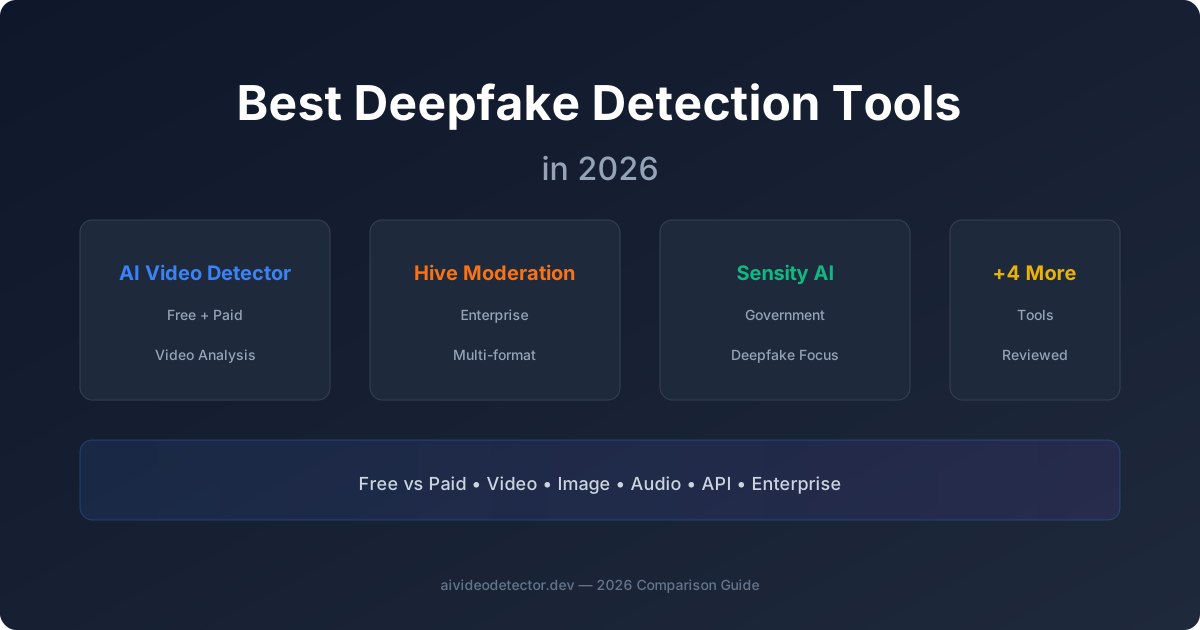
Deepfake detection has become a daily concern for journalists, content moderators, and anyone who watches online video. The market now includes specialized video scanners, multi-modal platforms, and enterprise APIs — each with different strengths, pricing, and coverage. Here are the tools worth knowing in 2026.
AI Video Detector
AI Video Detector is a self-serve web tool for video verification. Paste a YouTube, TikTok, or Instagram URL, or upload an MP4, MOV, or WebM file. The scan returns a verdict, a 0–100 confidence score, evidence frames highlighting suspicious regions, and reason codes explaining the result. The free tier offers 3 scans per day with no account required. Paid plans start at $9.99/month (Starter) and $19.99/month (Pro) with social URL parsing, scan history, and PDF exports. It is purpose-built for individual reviewers, journalists, and fact-checkers who need structured video evidence without API integration. For a detailed comparison, see AI Video Detector vs Hive Moderation. Check pricing for current plan details.
Hive Moderation
Hive Moderation is an enterprise content moderation platform covering images, text, and video. It uses an API-first approach — you integrate it into your upload pipeline and it classifies content at scale. Hive does not offer a self-serve free tier; pricing requires contacting sales. It is best for platforms processing thousands of uploads per hour that need automated moderation across content types. Hive returns classification labels and scores, but does not provide frame-level evidence or reason codes the way specialized video detectors do.
Sensity AI
Sensity AI is an enterprise deepfake detection platform aimed at government agencies and large organizations. It offers deepfake and synthetic media detection across formats with API integration. Sensity uses custom enterprise pricing with no public free tier. Detection scores come with limited explainability — useful for risk scoring at scale, but less transparent for individual reviewers who need to understand why a video was flagged. For independent users, AI Video Detector vs Sensity breaks down the differences.
Deepware Scanner
Deepware Scanner is a free, web-based deepfake scanner from Turkey. Upload a video or paste a URL to get a basic risk assessment. It focuses on face-swap and synthetic manipulation signals. Deepware also offers on-premise deployment and API access for enterprises — contact their team for pricing. The output is less structured than dedicated evidence-based tools, but for a quick free check it remains a solid option. For a feature-by-feature comparison, see AI Video Detector vs Deepware Scanner.
AI or Not
AI or Not is a multi-modal platform covering images, video, audio (voice and music), and text. It charges from $0.01 per second of video with $5 in free credits to start, and a Pro plan at $5/month. For videos over 30 seconds, it analyzes only a portion and recommends splitting into segments. AI or Not is useful when your review workflow spans multiple content types — not just video. If you primarily verify video clips, a specialized tool gives deeper evidence per scan. See AI Video Detector vs AI or Not for more detail.
Illuminarty
Illuminarty focuses on AI image and text detection with model identification — it can tell you which public AI model likely generated a still image and highlight AI-generated regions. It does not offer dedicated video scanning. Paid plans run $10/month (Basic) and $30/month (Pro), with a free tier for basic checks. Illuminarty is best for users who work primarily with still images. For video-focused workflows, see AI Video Detector vs Illuminarty.
Free vs Paid: What You Actually Get
Free tiers from tools like AI Video Detector (3 scans/day) and Deepware Scanner work well for occasional verification. If you review videos daily — as a journalist, moderator, or content creator — paid plans add scan history, evidence exports, social URL parsing, and higher volume limits. Enterprise tools like Hive Moderation and Sensity are priced for organizations, not individuals. The right choice depends on your volume, content type, and whether you need structured evidence or bulk classification. For most individual reviewers, a specialized video detector with a free tier is the right starting point.
How This Article Was Created
Pricing and feature details in this article were sourced from each tool's public website as of June 2026. AI Video Detector's own details reflect the product at the time of writing. Tool capabilities and pricing may change — verify with each provider's website before making purchasing decisions.