AI Detection in Education
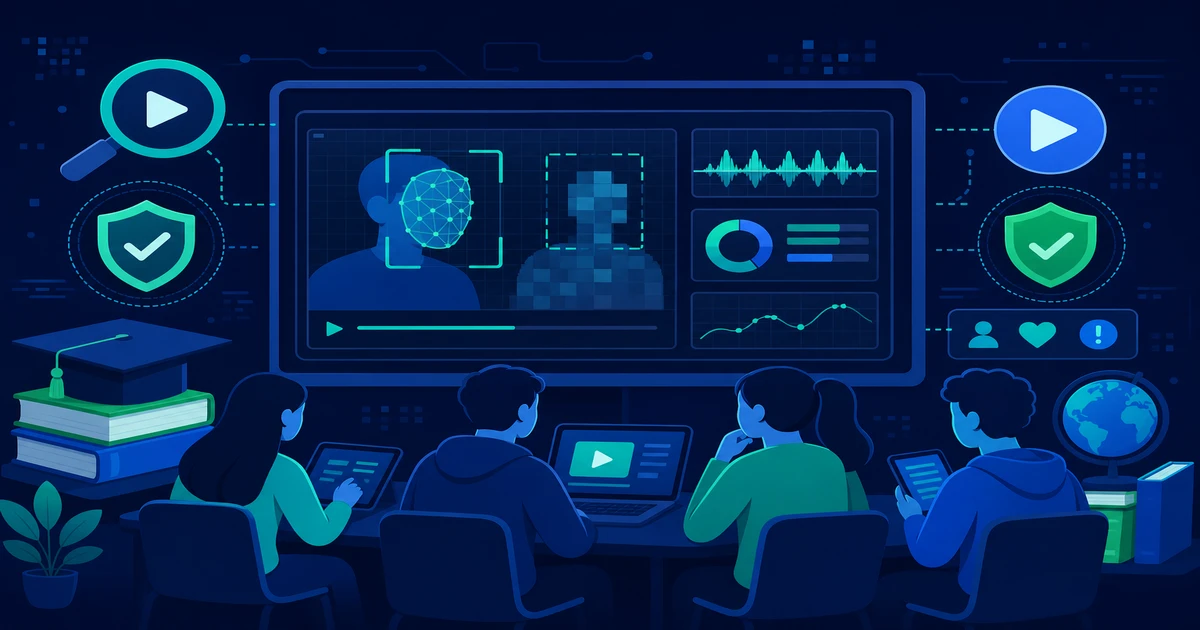
**Short answer:** Educators can incorporate AI video detection tools into media literacy curricula by using live demonstrations of deepfake analysis, assigning hands-on verification exercises, and teaching students the systematic workflow of source checking, automated detection, and critical evaluation. The goal is not to make students paranoid about every video they see, but to give them a practical framework for evaluating video authenticity when it matters.
Media literacy has always been a moving target. Twenty years ago, it meant teaching students to evaluate the credibility of written sources. Ten years ago, it expanded to include social media and image manipulation. Today, it must address synthetic video — AI-generated footage that can show anyone saying or doing anything. Students at every level, from middle school to graduate programs, encounter deepfakes in their information environment. Educators who ignore this reality are leaving their students unprepared.
Why Deepfake Literacy Matters in Education
Students are among the heaviest consumers of video content. According to Common Sense Media, the average teenager spends several hours per day consuming video content across social platforms, streaming services, and messaging apps. Much of this content arrives without clear sourcing — shared by friends, surfaced by algorithms, discovered in group chats. The line between authentic and synthetic video is invisible to most young viewers.
The consequences of deepfake illiteracy extend beyond being fooled by a single fake video. Students who cannot evaluate video authenticity are more vulnerable to misinformation campaigns, more likely to share manipulated content, and less equipped to participate in democratic processes that depend on informed citizens. They also lack a critical skill that employers increasingly value: the ability to evaluate the reliability of digital information.
Media literacy education in the age of deepfakes is not about teaching students to distrust all video. It's about teaching them when and how to apply verification skills — recognizing the situations where video authenticity matters, knowing the tools and techniques available to check, and developing the habit of pausing before sharing content that provokes a strong emotional reaction.
Classroom Activities Using AI Video Detection
The most effective media literacy lessons are hands-on. Students learn more from verifying a video themselves than from hearing a lecture about deepfakes. Here are five classroom activities that use AI video detection tools to build practical skills:
**Activity 1: The Deepfake Challenge.** Present students with a mix of 10 authentic and 10 AI-generated videos. Have them watch each video and record their gut instinct — real or fake? Then introduce AI Video Detector and have them run each video through the tool. Compare their initial guesses with the detection results. Discuss: What visual cues did they catch? What did they miss? How did the tool's evidence frames change their assessment? This activity builds awareness of how unreliable visual intuition alone can be.
**Activity 2: Evidence Frame Analysis.** Show students a flagged video and the evidence frames from the detection tool. Walk through each frame: what is the tool highlighting? Why does a facial landmark shift at the jawline suggest face swapping? Why does a lighting inconsistency between the face and background indicate synthetic generation? This teaches students to read detection output critically, not just accept a verdict blindly.
**Activity 3: Source Verification Workflow.** Give students a viral video with no clear source. Have them work through a full verification workflow: check the upload source, search for earlier versions using reverse video search, examine any available metadata, run the video through detection, and cross-reference the content's claims with reliable sources. Have each student or team present their findings and a verdict. This builds the systematic verification habit that extends beyond video to all digital information.
**Activity 4: Create and Detect.** Have students use an AI video generation tool to create a short synthetic clip — a face swap, a voice clone, or a text-to-video generation. Then have them run their own creation through detection tools. This exercise demystifies both creation and detection: students see firsthand how easy it is to create a convincing fake and how detection tools identify signals that human eyes miss. It also builds empathy for the detection challenge — students discover that their "obvious" fake might not look obvious to others.
**Activity 5: Election Simulation.** Design a mock election scenario. Some teams create campaign videos (mixing authentic and AI-generated content). Other teams serve as fact-checkers who must verify each video before it's published to the class's simulated news feed. The exercise teaches both the creation side (how easy it is to produce misleading content) and the verification side (how much work it takes to catch it). Discuss the asymmetry: creating a deepfake takes minutes, but verifying it properly takes hours.
Building a Media Literacy Curriculum Around Deepfakes
A one-off lesson on deepfakes is useful but insufficient. Deepfake literacy should be integrated across the curriculum, not treated as a standalone topic. Here is a framework for building it into existing courses:
**Foundations (Middle School).** Introduce the concept that video can be manipulated. Show simple examples of edited video — clips taken out of context, slow-motion to change emotional impact, audio dubbed over different footage. Build the habit of asking "where did this come from?" before believing or sharing any video.
**Intermediate (High School).** Add technical depth. Explain how AI generation works at a conceptual level — not the math, but the idea that models learn patterns from training data and generate new content that mimics those patterns. Introduce detection tools and have students practice using them. Connect deepfake literacy to civic education: how does synthetic media affect elections, public trust, and democratic participation?
**Advanced (University).** Explore the full ecosystem. Discuss the arms race between generation and detection models. Examine the legal and ethical landscape — what laws exist, what rights do people have over their digital likeness, how should platforms handle synthetic content? Assign research projects where students investigate a real-world deepfake incident and write an analysis covering the technical, social, and policy dimensions.
Tools and Resources for Educators
Educators don't need expensive software to teach deepfake literacy. Several tools are available at no cost or low cost for classroom use:
AI Video Detector offers free scans that work well for classroom demonstrations. Students can upload short clips and see detection results with evidence frames — enough to learn the verification process without requiring a paid subscription. For a full comparison of available tools, see Best Deepfake Detection Tools 2026.
Reverse video search tools — Google's video search, TinEye, and InVID Verification — help students practice source checking. These are free and work in any browser.
Fact-checking databases — Snopes, PolitiFact, FactCheck.org, and IFCN signatories worldwide — provide verified assessments of viral claims and videos. Students can practice checking a viral video against these databases before sharing it.
Academic resources from organizations like the Stanford History Education Group, the News Literacy Project, and First Draft provide lesson plans, assessment rubrics, and teaching guides specifically designed for media literacy instruction. These resources save educators significant preparation time.
Addressing Student Concerns and Emotional Impact
Teaching about deepfakes can be unsettling for students. Some react with anxiety — if any video can be faked, how can I trust anything? Others feel helpless — if the technology is this powerful, what can I do about it? Educators need to address these emotional responses directly.
The key message is empowerment, not fear. Students don't need to verify every video they encounter. They need to know how to verify video when it matters — when the stakes are high, when the content provokes a strong reaction, when someone is asking them to believe something or take action based on a video. Most of the video content students consume — entertainment, personal communications, educational material — doesn't require deepfake verification. The skill is knowing when to apply it.
Frame detection tools as empowering, not threatening. A student who knows how to use AI Video Detector has a superpower that most of their peers lack: the ability to check a suspicious video in seconds and make an informed judgment. That's not anxiety-producing — that's confidence-building. For an overview of detection techniques suitable for educational use, see How to Detect AI-Generated Videos.
Measuring Learning Outcomes
How do you know if deepfake literacy instruction is working? Pre and post assessments can measure changes in students' verification behavior. Before instruction, show students 10 videos (5 real, 5 fake) and ask them to assess each one. After instruction, show a different set of 10 videos and measure whether their accuracy improved, whether they used verification tools, and whether they cited specific evidence in their assessments.
The most meaningful outcome is behavioral, not knowledge-based. A student who can define "deepfake" on a test but doesn't verify a suspicious video before sharing it hasn't achieved media literacy. A student who routinely pauses to check the source of emotionally provocative video — and knows how to use detection tools when the stakes are high — has.
Long-term, track whether students are applying verification skills outside the classroom. Are they sharing fewer unverified videos? Are they citing sources when they share political content? Are they teaching friends and family what they learned? These behavioral indicators tell you whether the curriculum is producing genuine media literacy or just academic knowledge.
FAQ
### At what age should students start learning about deepfakes?
Basic concepts — that video can be manipulated, that seeing is not always believing — can be introduced as early as upper elementary school (ages 9-11). Technical understanding of AI generation and hands-on detection tool use are more appropriate for high school and university students. The key at every age is building the habit of asking "where did this come from?" before trusting or sharing video content.
### Can students use AI detection tools without creating accounts?
Yes. AI Video Detector allows free scans without requiring account creation, which makes it practical for classroom use where creating accounts for 30 students is impractical. Students can upload short clips directly and see results immediately. For longer videos or batch processing, an account may be needed. Check the tool's current terms for classroom use policies.
### How do educators stay current as deepfake technology evolves?
Follow a few key sources: the Partnership on AI publishes regular reports on synthetic media trends, academic conferences (CVPR, NeurIPS, AAAI) publish the latest detection research, and organizations like the Alan Turing Institute and MIT Media Lab maintain accessible resources for educators. Building a relationship with your school's IT department or a local university's computer science program can also provide ongoing technical support as the technology changes.
Sources
How This Article Was Created
This article was written by the AI Video Detector product team. Media usage statistics reference publicly available reports from Common Sense Media. Classroom activity suggestions are based on educational best practices for media literacy instruction.